
Last week, BCDA had the opportunity to attend the 8th annual Connecting Entrepreneurial Communities (CEC) Conference in Tekamah, Nebraska, and came home with a notebook full of ideas and a renewed sense of what’s possible right here in Boone County.
Hosted by Rural Prosperity Nebraska, CEC sessions took place inside locally owned businesses throughout downtown Tekamah. You learn in the community, not just about it. That distinction matters more than it sounds, and it set the tone for two days of conversations that felt genuinely exciting.
This year’s theme was “The Future is Local.” Session after session reinforced that the communities winning right now aren’t waiting for outside forces to save them. They’re looking inward at what they already have, who’s already showing up, and what’s already working and building from there. Here are some key takeaways.
1. We Have More Than We Think — We Just Have to Map It
Becky Boesen of Nebraska Community Foundation (NCF) discussed what’s called asset-based community development. A framework that starts not with what’s missing, but with what’s strong.
The session challenged a habit many of us in economic development fall into: leading with deficits. We talk about what we don’t have, what we’ve lost, what we need. Asset mapping flips that. It asks: What’s already here? Who are our connectors? What are we not celebrating that we should be?
The good news is that Boone County is already doing this work. Through multiple organizations, including the Boone County Foundation Fund, our community has been investing in local strengths and connecting people to resources for years. Asset mapping isn’t a foreign concept here; it’s a framework that can help us formalize and build on what’s already happening. The abundance is there. We just need to keep seeing it and keep telling that story.
2. Microbusinesses Deserve the Biggest Support
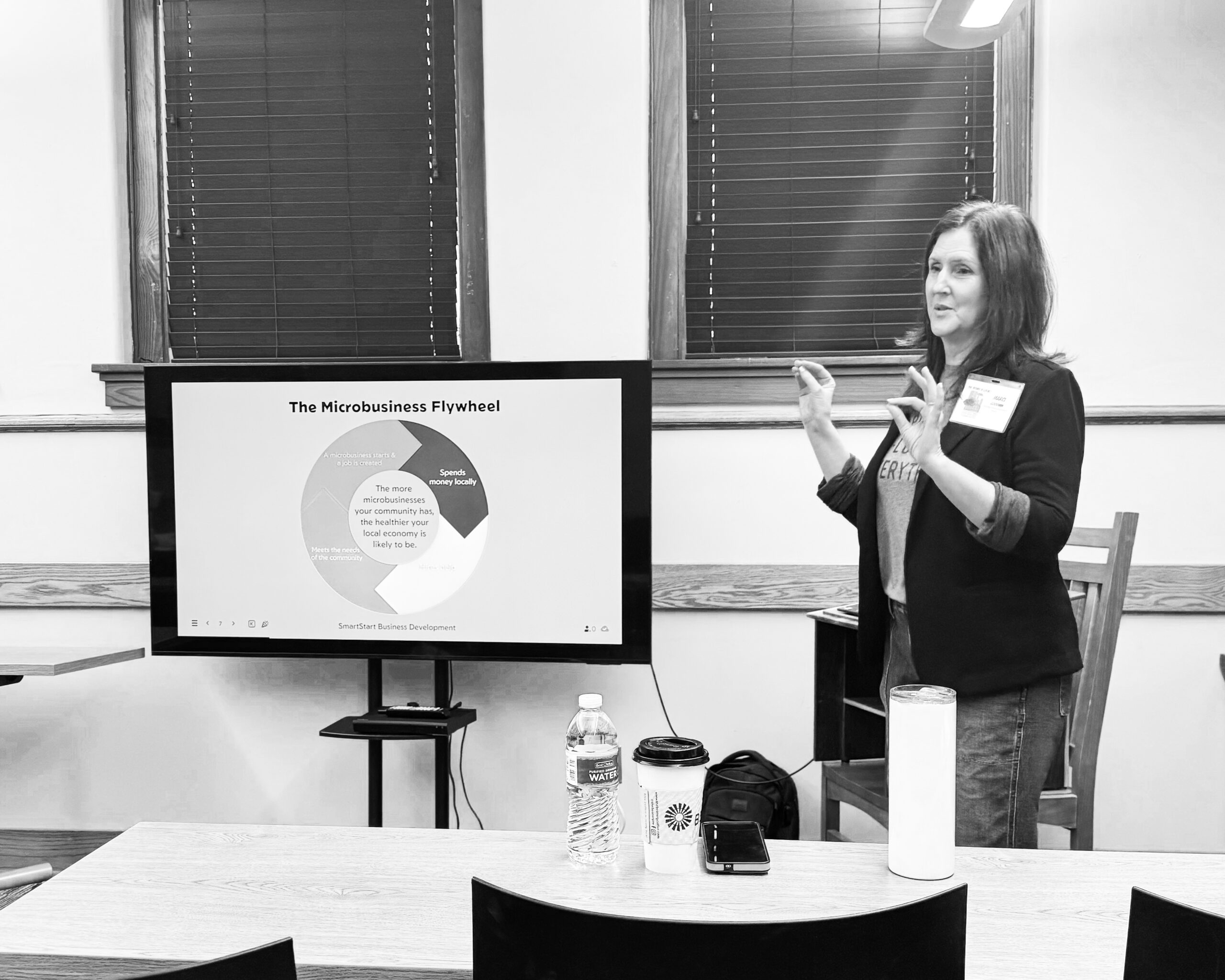
Two back-to-back workshops led by Marci Goodwin of SmartStart made a compelling case for why microbusinesses, the side hustle, the home baker, the one-person service provider, are actually the backbone of rural economies, even though most small business support systems were never designed with them in mind.
These businesses keep dollars circulating locally. They fill storefronts. They create a sense of place. And yet they’re often invisible to the support structures around them because they don’t fit the typical mold of a “business.”
She focused on understanding what support already exists in your community before launching anything new, and identifying where the real gaps are. The insight that stuck is that often, the gap isn’t resources. It’s visibility and coordination.
This is where I felt Boone County had a genuine edge in the room. Through BCDA, we’ve already built a suite of programs designed specifically to meet entrepreneurs where they are, including Energizing Entrepreneurs, Gap Financing, Marketing support, and Business Transition resources. These aren’t abstract ideas; they’re active programs helping real Boone County businesses right now. What the conference reinforced is how important it is to make sure those programs are visible and accessible to the microbusinesses that need them most, the kitchen-table startups and one-person operations that might not even know support like this exists in their own backyard.
3. Business Coaching Is an Economic Development Strategy
Doris Lux of Nebraska Extension made a strong case for investing in dedicated business coaching as a core economic development tool. Not as a luxury, but as a strategy that protects the community’s investment in its entrepreneurs.
The key distinction: a business coach is not the economic development organization. The coach’s role is to deeply understand the needs of individual entrepreneurs and walk alongside them, something that’s difficult for an ED group to do at scale. Communities that have invested in coaches, like Central City, which used Economic Development Administration (EDA) funding to bring one on staff and kept the position going after the grant ended, have seen meaningful results in business sustainability and growth.
This is a conversation worth having in Boone County. As our existing businesses face transitions and new entrepreneurs emerge through programs like Energizing Entrepreneurs, having access to consistent, qualified coaching could make a significant difference in long-term outcomes. Whether that means a staff position, a contracted coach, or a shared regional model, the idea deserves serious exploration.
4. Business Transition Is Everyone's Conversation
Jason Tuller of Nebraska Extension led a session on business transitions that our office has been passionate about for the past few years.
Some key insights worth sharing:
- Business owners need to understand that their business is valuable to the community, not just to themselves.
- Books that don’t accurately reflect a business’s performance can take up to five years to correct, directly impacting what a business can be valued and sold for.
- The timeline for a new owner to secure financing can stretch six months to a year, meaning transitions require far more lead time than most owners expect.
The communities that handle succession well are the ones that normalize the conversation long before it becomes a crisis, and that’s exactly the approach BCDA takes. Through our Business Value & Transition program, we work with Boone County business owners to understand their options, get their financials in order, and plan for a transition that protects both the owner’s legacy and the community’s economy.
If you own a business and haven’t started thinking about what comes next, now is the right time to start that conversation.
5. Cooperatives Are a Creative Tool for Community Needs
Charlotte Narjes and Cindy Holden of Nebraska Extension and the Nebraska Cooperative Development Center introduced a session on community-supported enterprises and cooperative models, and it opened the door to some creative thinking about how rural communities can meet needs that the traditional market isn’t serving.
Cooperatives aren’t one-size-fits-all. The session covered childcare cooperatives owned by groups of local employers (like the Norfolk Area Childcare Collaborative), cooperative models for local grocery stores in food desert communities, and investment cooperatives. Critically, any industry in Nebraska is eligible to become a cooperative, and USDA offers both grants and loan programs to support their development.
For Boone County, this is worth keeping on the radar. Childcare access and local food availability are both real challenges in rural Nebraska. Cooperative models offer a community-owned path forward that doesn’t rely on outside businesses to swoop in and solve local problems. The Nebraska Cooperative Development Center is a strong resource for communities wanting to explore this further.
6. Events Are Economic Development — If You Design Them That Way
Kristin Malek of Nebraska Extension led a session on using events as an economic development strategy, and it reframed how to think about community programming. Events aren’t just nice things to do. When designed intentionally, they attract visitors, support local businesses, strengthen community identity, and, critically, give people a reason to come back.
The keyword is intentional. There’s a difference between an event that happens in a community and one that’s designed to generate economic impact. Are we thinking about where out-of-town visitors will eat and shop while they’re here? Are we creating experiences that make people want to return? Are our events telling the story of who we are?
7. Creative Districts Are Closer Than You Think
The session on Creative Districts, moderated by Rachel Morgan of the Nebraska Arts Council, featured community leaders who have gone through the state’s creative district certification process and shared what it’s meant for their communities economically, for tourism, and for community engagement.
The message from smaller communities was clear: creative district certification isn’t about having a booming arts scene already in place. It’s about recognizing and formalizing the creative energy that’s already present and using that as a framework to attract visitors, support local artists and makers, and build community identity.
Boone County doesn’t have to look far to find that energy. The Albion Area Arts Council has been cultivating a vibrant arts community right here at home, creating opportunities for local artists, engaging residents of all ages, and strengthening the cultural fabric of the county. That kind of grassroots momentum is exactly what creative district certification is designed to build on. The foundation is already there, and the question worth exploring is what formalizing it could unlock for Boone County’s economy, tourism, and sense of place.
Coming Home Ready to Work
What made CEC different from other conferences wasn’t just the content; it was the format. Walking through Tekamah’s downtown, seeing sessions unfold inside real businesses run by real people, made everything feel possible in a way that a conference room never quite does. These weren’t theoretical ideas. They were strategies that communities just like ours have already put into practice.
What stood out most is how much Boone County is already doing. The Boone County Foundation Fund is investing in local strengths. BCDA has built real programs, Energizing Entrepreneurs, Gap Financing, Marketing support, and Business Transition, designed to meet entrepreneurs where they are. The Albion Area Arts Council is cultivating creative energy that could anchor something even bigger. The work is happening. The people are showing up.
The 2026 CEC Conference reinforced what many in Boone County already know: economic development isn’t just about jobs, it’s about place. And Boone County has the organizations, the people, and the momentum to keep building a place worth choosing. The opportunity ahead is making sure those efforts are visible, connected, and reaching the people who need them most.
To learn more about economic development resources available in Boone County, reach out to BCDA at bcdaadmin@boone-county.org.